This tip should really be something that goes without saying, but a lot of people actually don't do this! If there is any possible way, I highly recommend that you go out and preview whatever race course you will be racing. Whether it's a swim, bike, run, all of the above, or whatever, there is a ton of information you can gain from getting out there and doing the course prior to race day.
For swimming, if you can get in the water and figure out some large objects that are easy to see to use for sighting, instead of the buoys that are typically hard to see. You also get a feel for the water and whether or not it's choppy, cold, dirty, clean, whatever.
Biking on the course will allow you to learn first-hand when you can push and when to relax. There may be times that seem flat to your eyes, and yet are actually a gradual incline. Or maybe there's a hill with a curve on it, so you can figure out how long the actual climb is. You also get to learn the condition of the road and if there's any large potholes or dangerous spots to look out for.
Running early has similar benefits to biking. Another added bonus is that you can figure out which way the course actually goes, so if you find yourself alone at some point in the race, and by chance the course is poorly marked, you still have a general idea of where to go!
There are a ton of other benefits to getting out on the race course prior to race day, and I'm sure you can probably think of some that I didn't mention. The point is, there are a lot of benefits. It's that simple! So next time you have a race coming up, and assuming it's possible to do so, go practice your race on the course!
Today's tip may not sound like a training tip at first, but it is. And it's very simple. In light of the new Boston Marathon registration process, which gives preference to those runners who finish fastest in their respective age/gender category, the qualifying standard is no longer going to be the same every year. Sure, the "official" cutoff for my category (M18-34) is now 3:05 and does not allow a fifty-nine second grace period as previous years have. The tricky part is not knowing how fast every other Boston Qualifier ran.
Look at my situation for this current year. I finished a marathon in 3:10:25, which technically qualified me for the Boston Marathon using the :59 grace period (my standard was 3:10:00). Since registration is no longer a first come/first served process and is done strictly on the amount of time that you beat your qualifying standard by, I'm at the bottom of the barrel. Nobody knows for sure how fast you have to run in order to be able to get in, but it seems that everyone who ran five minutes faster than their standard is going to get in with no problems. For me, that would mean that if I would have ran a 3:05:00, I would almost definitely get in. This actually is the fairest way that the Boston Athletic Association could do registration (I think), as it actually does reward the faster runners, not just those with the fastest internet connection.
So in short, today's tip is this: If you are looking to qualify for the Boston Marathon some day, there's two things to know. First, make sure you check the BAA website for current qualification standards prior to your race day. Second, if you want to be almost certain that you'll be able to register, you need to plan on beating your age/gender standard by at least five minutes. And in fact, the more you beat your standard by, the better off you'll be!
If you've ever participated in a large endurance event, whether it be a half marathon, marathon, or Ironman, you know that there are a lot of spectators. And when you're a participant, you're not always concerned with looking for your loved ones that are out there cheering you on, since you're typically focused on getting through the race. Usually, though, it does provide a pick me up when you do happen to see your support crew.
There are a few different things you can do to make finding your supporters a little bit easier, and really make your support crew's day a lot better too. First, you can agree on a location that they are going to be at prior to the race starting. Then, once you get to that area, you know to keep your eyes open for them. What we've done for the last few races, and actually works really well, is The Wife gets a balloon the day before the race. This way, when I'm out on the course, even if I'm not exactly paying attention, a balloon almost always catches my eye! It makes it very easy to spot my family and get that little burst of energy!
Sometimes us athletes need a little reminder that the race isn't only about us, it's about the spectators as well! I actually think that the athletes have the easier job of the day. Our job is cut and dry. The spectators have the harder job of standing around and playing "Where's Waldo?" all day long. There's no way I could do that! So during your next race, make sure you at least give your supporters a big smile and wave and really thank them for giving up their day to support you!
I don't think it matters how often you race, or whether you're racing for fun or trying to place. I believe that everyone has some sort of pre-race anxiety or jitters. I know that I still get nervous, regardless of what my goal for the race is. Many people have different rituals that they follow or good luck charms that they carry with them. I don't necessarily have any of that, but I do have a pretty basic routine that I follow.
During the day before most of my races, I try to get a light workout in. If I'm doing just a running event, then I'll get a very short run in, maybe a couple of miles. If I'm doing a triathlon, my light workouts have been going on for a few days. Basically, the day before a race I try to relax and stay as low-stress as possible. I try to eat meals that are on the lighter side (not necessarily smaller portions than normal, just not heavy meals). For dinner, I almost always have some sort of pasta and sauce, and I've learned the hard way to eat a smaller portion than I normally would for dinner. I try and have dinner a little earlier than normal, and head off to bed with plenty of time to sleep.
Sleeping is a tough issue because it's almost near impossible to actually get a good nights sleep. Some people take NyQuil to help them sleep, other people will take other over-the-counter medications to aid in sleeping. I've tried the NyQuil approach, and I was way too groggy in the morning. Now, I just go to bed extra early, knowing that it's going to take me a long time to fall asleep. I like to wake up about three hours prior to the race (depending on the race obviously. Triathlons may require a little more time before the race). When I wake up, I have some sort of small breakfast...maybe a bagel and a banana, or maybe an Ensure (like an instant breakfast shake). I also get the coffee brewing and have a decent sized cup of coffee right when I wake up. Once all of that is done, I slowly sip on a small bottle of electrolyte drink. This is key, because you have to make sure you don't drink too much, otherwise you will be needing to visit the port-o-let quite often.
After all of this is done, it's time to head on down to the race and enjoy the day! Some other things that you can do to help settle the nerves is listen to some music, do some light stretching (and I do mean light! You don't want to pull a muscle before your race starts!!!!), or maybe even just head down to the race start to get excited for the race!
Whatever you do, it takes a little trial and error. Once you find something that works, try to replicate that each time you race, because it will help keep you calm and relaxed.
Hopefully everyone out there does this already, but there's some that might not. I recommend always bringing a phone with you when you are out doing your training. Even if you're only going out for a few miles and don't think that you are going to be far from home.
When I'm out on my bike, I always have my phone with me, and I've had to use it a few times. The obvious reason why you might need to call someone is that you got a flat tire. Hopefully you carry a spare tube and some CO2 cartridges so you can change a flat. But I've had the unfortunate luck of getting two flats at the same time! Since I only carry one spare tube with me, I was unable to repair the second tire and therefor needed a ride home. Bummer. Another reason to have your phone on the bike is in the case that you have a little crash. Bike crashes aren't all that uncommon, and you never know if you're going to bend a wheel or break a chain. There's many other reasons to carry a phone on the bike. Don't waste your time thinking about all of them, rather spend your time figuring out how to get your phone on your bike!
When I run, I stash my phone in my water belt. I don't typically venture out too far from home when I'm running, but there's always that chance of twisting an ankle or pulling a muscle. I don't usually have an excess amount of time, so if I had to limp home halfway through a run I'd probably be really late for something.
Lastly, you never know if someone is going to need to get in touch with you. My rule of them is that I typically screen my calls while I'm training. If it's someone who knows I'm out training and they are still calling, I figure it might be important (like when The Wife calls me). If I don't know why they're calling it, it let it go to voicemail and figure that if it's really important, they'll call again.
It's mostly a safety precaution, but carrying your phone is one of those things that might give your or your family some peace of mind while your running or riding around out there with all of those crazy drivers. Do yourself, and your family, a favor and figure out how to start bringing your phone with you when you train.
This tip is a short and simple one. I find that if I have a long workout planned for the morning, or even a short one for that matter, it's much better for me if I set all of my stuff out before I go to bed. It's much nicer to wake up in the morning and relax before the workout than to feel like I'm rushing myself trying to get water bottles filled, tires pumped, Garmin pieces all together, whatever. It may not seem like much, but it really is.
It is even more beneficial to pack the night before when you are doing a long workout, or traveling to your workout location (pool, driving to meet up with someone, whatever). It gives you a chance to get an almost "pre race" experience. When I am preparing for a 4 hour bike ride, the night before I make sure that I have all of my water bottles and all of my nutrition, whatever spare tubes I will taking, and any other things I may be using on my ride. Then when I wake up in the morning, all I have to do is go through a quick checklist to make sure one last time that it's all there. And as an added bonus, it gives you the option to sleep in for just a few extra minutes if you'd like!
I personally do this just about every night, since I almost always have early morning workouts. It's very nice to be able to take my time waking up instead of hearing the alarm going off and waking up in panic mode because I now have to find all of my required items mentally prepare for my workout at the same time. Try it out...I'm sure you'll like it.
Maybe this weekly tip goes without saying, but sometimes it just takes reinforcing. Even for those who have been training for a few years. There isn't anything wrong with trying something new, depending on when you try it.
The best time, or in my eyes, the only time to really try something new (anything major at least) is during the off-season. During this time, there's not to much concern if you screw things up. Trying something new, whether it's a new running technique, new bike position, whatever, is likely to cause some type of backfire, at least for a short amount of time. Even if it is going to improve you over time, there may be an adjustment period. So it's best to do it during the off-season so you can slowly transition and not worry to much about getting injured.
If you happen to try something new during a racing season, just be very cautious before you begin, and do your research. Find a way to ease into it, and back off at the first sign of injury. But it at all possible, keep all new things until the off-season. It's much better to complete a healthy season than to get injured trying to improve something ever-so-slightly. Save that for when there's not a race on the line.
The first time that I actually followed a training plan, I was blown away with the results. For my first three Ironmans, and all of the half marathons and marathons that I had run before those, I didn't stick to my training very well. And each time, I finished feeling like I could do better. When I finally followed a plan, almost perfectly, I set a PR that I'm not sure I'll be able to beat!
Before training for the Goofy Challenge, I would just go out and run, or go out and bike, without any purpose other than going for a certain distance. I now know that having a goal for each and every workout is like racing every day. It's awesome! Whether your goal is to keep a certain pace, go for a certain amount of time (which I recommend over using mileage as a goal), or trying to keep your heart rate under or over a certain point, setting goals gives you something to focus on and something to work toward while your training. It also can break up your workouts into smaller workouts so you feel like your accomplishing something each time you train. Also, by using certain workouts every few weeks, you can test yourself and see your progress!
It has taken me a few years to really learn some ways that I can get motivated for training and to stay on track. Without setting daily goals, I would find myself feeling like I was burned out, or feeling like it was ok to skip a few days in a row (which, if you're burned out, then yes, take a few days off!). Maybe this won't work for you, but you should at least give it a try.
Just for a quick example, I usually set pace goals for my shorter workouts, or the ones where I'm trying to improve my speed. Typically these are a handful of sprint repeats. For my mid distance workouts, I also set a pace goal, but I pay more attention to my heart rate. I try to maintain my goal pace, but will drop back if my heart rate starts to get too high. For my long workouts, I simply set a time goal and go knock it out. For these workouts, I pay pretty close attention to my heart rate, and don't really care too much about speed...if I'm doing the right short and mid distance workouts, the speed will be there for the longer workouts. If this doesn't make sense, let me know and I'll clarify whatever I can for you!
If you've decided to train for an Ironman, hopefully you did enough research to realize that the training is going to be a part time job, that you're not getting paid for, so you have to be quite motivated. If you didn't figure this out before you decided on triathlons, well, SURPRISE! You are now going to have to re-work your life and find 10-20 hours/week for training!
When I started training for my first Ironman, I didn't really have much of a plan. I tried looking up some things online, but most plans were pretty generic. And being the moron that I am, I thought I could develop a better plan on my own. And that plan consisted of riding my bike once or twice a week for as long as I could, running every now and then, and swimming maybe once a week. I was definitely over-training in the "recovery" discipline. My first Ironman, though I finished, wasn't what I had envisioned in my head. I was very, very excited that I was able to cross that finish line, but I was left with the feeling of not having performed to my fullest potential.
Since then, I've read a ton of books, read probably every article on the internet, and even stayed at a couple Holiday Inn's. I am now under the impression that training more frequently is more important than training for longer durations. No, I'm not saying that you don't need to run over 20 miles prior to an Ironman, or that you don't need to bike 100 miles prior to an Ironman. I'm saying that you don't need to do it every week.
For most triathletes, time is very precious. It's much easier to get in 3 or 4 bike workouts, for a shorter duration, rather than going out for 6 hours (and the same is true for running and swimming). Most of us have a hard time finding 6 hours in one day to break free and focus on anything, let alone training. Don't get caught up in thinking that you need to go long every workout, or even every week. Sure, you need to build up to the race distance and actually do the race distances (separately of course) before the actual race. But you don't need to run a marathon every weekend.
By working out more often, your body is able to be in an aerobic zone more often, which will train your body to do all of the confusing chemical stuff that it does to allow you to sustain that aerobic effort. If you only workout a few times per week, you body won't get used to being in that zone. For me, my body seems to react pretty well to training each sport about 3 times per week. Some weeks I get in a little more, and some weeks I get in a little less. Also, by having roughly 9 workouts each week, you only have a few days where you are doubling up on workouts. For the days where you only have one workout, you can either choose to go longer, or raise the intensity level a bit. Do keep in mind that rest is important, and if you feel worn out, you probably are...so rest!
So remember, try and do a few shorter workouts and one longer workout for each sport during the week. If all you do is go long and slow for each workout, you probably won't have a lot of gains.
Once you've been competing, or at least completing, endurance sports long enough, you'll start to come up with your own little idiosyncrasies. Some of them you will pick up from other athletes, and some of them you will come up with all on your own, thinking that they are the greatest thing since Marky Mark and the Funky Bunch. And maybe it is! The only thing that really matters is that it improves your performance. If not, then knock it off!
One thing I like to do is order two pairs of running shoes every time I buy new shoes. I do this for two main reasons. First is that it makes my shoes last longer. Not last longer like I can magically put more miles on them before they go bad, but last longer as in an entire season as opposed to half of a season. The second reason is that by using two pairs of shoes and rotating them, your running shoes get more of a chance to "recover" and you get to run on fresher shoes each time you run.
I'm no scientist, and I have done any specific tests to measure how long it takes a shoe to return to it's normal state after being run in. I can only speak based off of what I have experienced. And that is fresh shoes, each and every time I run.
Most recently, I purchased two pairs of the Saucony Progrid Kinvara's. I purchased two different colors so it's very easy for me to tell which pair I'm using, and which pair is to be used next. When I was running in my Adidas Adizero Tempo's, I simply wrote a "1" and "2" on the back of the shoe so I could tell them apart. Pretty simple.
This tip won't apply to everyone, as some people won't see the need to purchase more than one pair of shoes, and I won't argue with them. I feel that I've been putting a fair amount of miles on my shoes, and having them last for an entire season (and not having to break in a new pair mid-season) is pretty nice. So try it out the next time you go to order your new running shoes!
Okay, so maybe what I do isn't really considered "pumping iron" like these guys:
But my goal isn't to be the size of a freight train. My goal is to be able to finish Ironman Arizona in under 12:00. So chances are that I approach the weight room slightly different than those (overly) bulky guys.
On the other hand, I also need to stay relatively strong for my job as a firefighter. Because of this, I can't strictly follow most of the triathlete-oriented weight lifting programs out there (I'll get to what I do later on). For the most part, what is recommended for triathletes is lighter weight and more reps. For example, if you would normally bench press 135 pounds, ten times without too much issue, you would probably drop down to 100 or 115 pounds and try to do 2 or 3 sets of 20 reps. On top of that, most books out there recommend doing triathlon-specific workouts (one's that will improve the muscles you are going to use during a triathlon). The almost completely takes out the upper body workouts, other than a few select moves. Here's a basic weight lifting day for a triathlete:
Squat: 3 sets of 20 reps
Leg press: 3 sets of 15 reps
Circuit (these 3 workouts are done immediately following each other): Straight arm pull down x 20 reps, followed by leg extensions x 15 sets, followed by dumbbell step ups x 20 reps (now do those 3 workouts, three times through).
As you can see, it is largely focused on legs. Why? Well, because your legs are what is going to get you to the finish line. A word of caution though...be sure to not use too much weight. You should already be doing a fair amount of running and biking, which already puts a lot of stress on your legs, so you don't want to overdo it with the weights. You really don't want to do more than one "leg day" per week.
As for what I actually do, it's a bit different. I have to find a balance between training myself to hold a steady state for a long period of time (for triathlons), and training myself to be able to handle moving all of my equipment around (my fire equipment weighs about 75 pounds or so). To do this, I'm constantly changing my workout routine, to try and include not only workouts with lighter weight and higher reps for my triathlon training, but workouts with heavier weight and less reps. What's more is that I can't neglect my upper body like those who only need to do weight training for triathlons. My job requires a fair amount of upper body strength, so I actually have to do a lot of focusing on that.
To put it simply, I usually do a week or two of heavy weight with less reps, followed by a week or two of lighter weight with more reps. I try and not do the same thing for more than two weeks.
Whether you focus strictly on the triathlon muscles, or you do a whole body workout, I definitely recommend using weights at least one a week during your training, and especially during the off-season. If you want a more detailed explanation of what I do, just get in contact with me and I'll be more than happy to write out my weekly weight training plan for you.
For many runners, the treadmill is their arch nemesis. Running on a treadmill is viewed as something that "real" runners don't do. I used to think this way, until I started thinking logically and realized that treadmills are a fantastic tool.
First off, if you're going to run on a treadmill, don't do it like this:
The most obvious use of a treadmill is when there is a day that you need to get a run in, and the weather is not cooperating. I also find that doing one or two of my weekly runs on a treadmill helps protect my legs a bit. Running outside, on hard surfaces, takes it toll on your legs. By running inside on the treadmill, you are able to take away some of that damage that is done. And yes, I know that running on a treadmill isn't the same as running outside. My argument to that is this: riding your bike on a trainer is not the same as riding outside, but there are more and more pro's that advocate doing a huge portion of your cycling training on a trainer.
In order to get the treadmill to resemble running outside as much as possible, there's a few adjustments that can be done. First off, try to keep the incline set to (at least) 1.0. When you have the treadmill set to an incline of 0, you do not have to work as hard to keep your positioning on the treadmill. The ground moves for you and all you need to do is shuffle your feet and not really provide yourself with any "forward" momentum. By increasing that incline, you have to work just a little bit to keep yourself in the middle of that treadmill.
The other thing that I like to do is try and set the treadmill at a slightly faster pace than I would normally run. Why? Well, the long and short of it is that if you are training based on your heart rate, running an 8:00/mile pace outside will require a higher heart rate than running an 8:00/mile on a treadmill would. So in order to bring that heart rate up to the same level, you can increase that speed slightly.
Here's an example of what I do on a mid-distance type of run:
*I leave the incline set to 1.0, unless I am going to be doing hill work.
Warm up: Start running at a speed of 6.0 for 1:00, followed by :30 of walking at a speed of 3.5. Then run for 1:00 at a speed of 6.5, followed by a :30 walk at 3.5. I repeat this process until I reach a distance of 1 mile, which is usually just under 10:00. Here's a full list of the speeds/times
6.0/1:00, 3.5/:30
6.5/1:00, 3.5/:30
7.0/1:00, 3.5/:30
7.5/1:00, 3.5/:30
8.0/1:00, 3.5/:30
8.5/1:00 and then I increase to 9.0 until I reach a distance of 9.7, at which point I walk at the 3.5 speed until I reach the 1.0 mile mark.
Main Set: For this example, I'll use a 6 mile set. Here's a breakdown of one way to do the set:
Mile 1 - use your goal race pace as a starting point. Let's use 7:15/mile, or a speed of 8.4.
Mile 2 - keep the speed where it is.
Mile 3 - keep the speed where it is.
Mile 4 - keep the speed at 8.4 until you reach a distance of 3.2 miles. At this point, increase the speed by .1, and continue to do so every .2 miles.
Mile 5 - by the start of mile 5 (when you hit 4.0 on the distance), you should be at the speed of 8.9. Continue to increase the speed by .1 every .2 miles.
Mile 6 - by the start of mile 6 (when you hit 5.0 on the distance), you should be at the speed of 9.4. Here, you can either continue to increase the speed, or keep it where it is, depending on how you feel.
Cool Down: For every run I do on a treadmill, my cool down is always the same. I take 5:00 to go roughly 0.3 miles. I do this by slowing down my speed to 4.5 for 1:00, 4.0 for 1:00, 3.5 for 2:00, and 3.0 for 1:00.
Here is one way to attack a long distance run on the treadmill:
*Again, I keep the incline set to 1.0 for every treadmill run, unless I'm doing hill work.*
Warm up: (the exact same for every workout) Start running at a speed of 6.0 for 1:00, followed by :30 of walking at a speed of 3.5. Then run for 1:00 at a speed of 6.5, followed by a :30 walk at 3.5. I repeat this process until I reach a distance of 1 mile, which is usually just under 10:00. Here's a full list of the speeds/times
6.0/1:00, 3.5/:30
6.5/1:00, 3.5/:30
7.0/1:00, 3.5/:30
7.5/1:00, 3.5/:30
8.0/1:00, 3.5/:30
8.5/1:00 and then I increase to 9.0 until I reach a distance of 9.7, at which point I walk at the 3.5 speed until I reach the 1.0 mile mark.
Main Set: Now lets say you are doing a 13 mile run. In most of my training, my "long" run days are run at a pace slightly slower than my goal race pace. So let's say you plan on running an average of 8:15/mile for your upcoming race. On a treadmill, you could set the pace anywhere from 8:30/mile to 8:00/mile and probably be alright. Here's what I would do:
I would break this long run up into smaller, equal parts. Let's do 3.25 sections (done four times equals 13!)
Pick your speed and keep it constant. Try to resist increasing your speed until the last 3.25 mile section.
After each 3.25 mile section, change the speed to 3.5 (or slower) and walk for a couple of minutes. I don't normally do this when I run outside, but I find that doing it when I am running on a treadmill allows me to focus better. That couple minute break is more of a mental break from running in place!
Most treadmills time-out at an hour (some less!), so make sure you know what your treadmill does before you start. Personally, I count the "reset" time in my overall time (I figure it's like stopping at an intersection if you're running outside).
If you're feeling good after the first 3 sections, go ahead and increase your speed *slightly* for the last few miles. I say slightly, because the point of the long run is to work on keeping your heart rate BELOW and certain level. So if you get your heart rate too high at the end, those last few miles are working you anaerobically instead of aerobically.
Cool Down: For every run I do on a treadmill, my cool down is always the same. I take 5:00 to go roughly 0.3 miles. I do this by slowing down my speed to 4.5 for 1:00, 4.0 for 1:00, 3.5 for 2:00, and 3.0 for 1:00.
Obviously, you would want to adjust the speeds for whatever you goals are, just be sure to not fall off like those knuckleheads from the video.
TREADMILL TIPS
There's a few things I do that make my treadmill experience a little more enjoyable than they used to be. Here's the short and sweet of them:
Bring a sports bottle to drink out of. Don't try drinking from a regular cup. Squeeze bottles of the best.
I bring a few small hand towels with me. I tend to get pretty sweaty on the treadmill, so I bring them to wipe off my face and arms. Actually, I give myself a little wiping every .25 of a mile. Not only does this keep me from dripping sweat all over the machine (which makes clean up a bit quicker), but it gives my mind another thing to focus on, other than running in place. I fold the towels in half twice and wipe, repeating to use the same side until I decide it's too sweaty. Then, I simply switch to a different side of the towel until it's all used up.
Just like any other longer workout, don't forget to use a sports drink and/or gel packs (or whatever other nutrition you plan on using during your race).
Find something that will keep you motivated during your run, whether it be T.V., a movie, music, reading a book, whatever.
Ok, that's all I can think of for now. Sorry for such a long post. I'm trying to do a better job at going a little more in depth, in case there's actually people out there that can use the info that I'm throwing out there! Now all that's left is for you to hop on a treadmill and get to work!
My personal opinion is that training with a partner is somewhat counter-intuitive, as it relates to the world of triathlon. I feel that it is such and individual sport, that there needs to be a huge amount of time spent training by yourself so you know how to perform on race day...by yourself. However, there are some great benefits to training with somebody, or a group of people.
The main benefit that I get out of scheduling a training session with a training partner (which is almost always The Captain, who just started his own blog! Check it out here), is that it greatly reduces the chance of skipping a workout. If you have someone that you are meeting up with, it's pretty tough to cancel on them, as opposed to when it is just yourself and you can make up excuse after excuse as to why you should skip a workout. The other huge benefit that I get out of training with other people is that you may be able to push yourself a little more than you expected. I know that if there's a day when I'm not feeling to into a workout, and I happen to be training with The Captain, it's very easy to feed off of his energy and I quickly find myself excited about the workout that we're doing! Also, there's been a number of times where we find ourselves quietly competing with each other, but not acknowledging it. For example, we'll push the tempo on a bike ride a little harder than we normally would to see who needs to pull it back first, which typically provides a really good workout!
What happens to work best for me is to schedule early morning workouts with my training partner. The early morning in Arizona is probably the best time to get a workout in without the temperature reaching 110 degrees. It's also the time of day that takes away the least amount of family time. If I am not meeting The Captain, it's very easy for me to hit the snooze button and get that extra hour or two of sleep. And as much as I know all of this, there's still times when I do hit that snooze button, and hate myself all day for doing it. So again, my advice is to periodically schedule your workouts with a training partner. And if you don't know any, let me know and maybe I'll be your new training partner (if you don't mind going for long bike rides starting at 5 a.m.!)
This weekly tip is actually for the fellas, believe it or not. And no, I don't mean "Save the ta-ta's". I'm talking about probably one of the most painful phenomena to happen during a long distance running event...chafing of the nipples.
This is typically only a problem for the men, as women usually wear sports bras. Men, however, usually wear loosely fitting tech shirts, which are constantly rubbing on the nips while running.
Did this guy spill ketchup on his shirt, twice?
I think this guy bought his shirt like this.
Yay for bloody nips!
Awesome. I can't lie, I've been there. It's not something that us guys usually take into consideration before a marathon. It usually only happens when we get on the sweatier side, but in all reality this ego-shattering, laugh producing tragedy can strike at any time.
There's been a few different companies that have tried to capitalize on this problem, and come out with products to protect our very delicate nips.
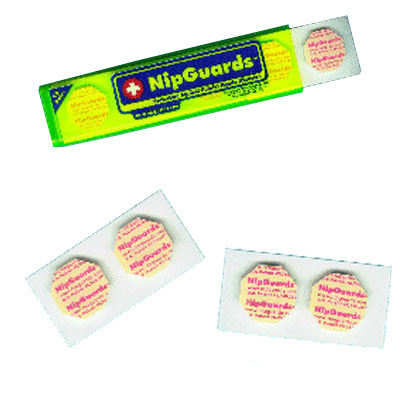
NipGuards are pick and stick products that cover the nip
Other companies, such as BodyGlide, have products that are simply applied and are "anti chafing" products. One product that I recommend against is Vaseline. Vaseline is probably the most widely handed-out product on race courses, probably due to it's cheap price and bulk quantity. However, if you use Vaseline, be warned: It will probably stain your shirt! This might be even more embarrassing than having bloody nips, because now every time you run you will have discolored spots on your shirt where your nips are. I've actually thrown away a shirt because of this.
My solution is much simpler, and maybe cheaper (I haven't really done the price matching to see, but I like to tell myself that it is). I simply put a band-aid over each nip before a long run, if I'm at all concerned that I'll have some irritation. During triathlons, it's not usually a problem, and likely the band-aids wouldn't stay in place during/after the swim anyway. But in the run-only setting, don't forget the band-aids!
I find it interesting that most drivers out on the road think that bicycles belong on the sidewalk. Actually, we don't belong on the side walk, thank you very much! Here is some stuff I took directly off of the Arizona Governor's Office of Highway Safety:
Bike Safety and Laws
According to Arizona State law, cyclists have the very same rights and responsibilities as motorists. Respect for the rights of ALL road users will help you feel good about yourself and avoid accidents too.
Most crashes between motorists and cyclists happen at intersections. Most often, when the motorist is at fault, it is because they failed to yield the right-of-way to the cyclist. This usually happens when you turn left in front of a cyclist, or pull out from a stop sign or driveway into a cyclist’s path.
Bike Safety Boogie! Yeah!
Arizona Bicycle Laws
ARS 28-644 Stop for traffic lights and stop signs
ARS 28-817 Always use a white headlight and a red rear reflector when you cycle after sunset or before sunrise
ARS 28-792 ARS 28-904 Yield to pedestrians at crosswalks and on sidewalks
ARS 28-756 Before you turn or change lanes, look behind you, signal to show your plan to turn or change lanes, and yield to any traffic already there. Cyclists may signal their turns by extending either their left arm for a left turn or their right arm for a right turn
ARS 28-721 Any vehicle moving slower than the normal traffic speed shall drive in the right-hand lane, or “as close as PRACTICABLE” to the right edge of the road, except when preparing to turn left or when passing
ARS 28-704 Any vehicle on a two-lane road that has five or more vehicles behind it must pull off at the first safe pullout to allow the vehicles behind to proceed
ARS 28-815 Special conditions that affect cyclists more than motorists are recognized in the law
Riding two abreast is permitted by law (A.R.S. 28-815)
You may ride far enough from the road edge to stay clear of surface debris, potholes, rough pavement, drain grates, and pavement joints, as well as to avoid pedestrians, dogs, parked vehicles, and other objects.
You may occupy any part of a lane when your safety warrants it. Never compromise your safety for the convenience of a motorist behind you.
Laws for Bicycle Riders Only
ARS 28-813 Every person riding a bicycle must have a regular seat to sit on
ARS 28-817 Every bicycle must have at least one brake that will make the wheel skid when applied
ARS 28-815 You may ride no more than two side-by-side, except on exclusive bike paths
ARS 28-816 You must have at least one hand on the handlebars at all times
ARS 28-814 You may not attach your bicycle to, or hold onto, another vehicle on the roadway
Bicycle Safety Tips
Before using your bicycle, make sure it is ready to ride. Always wear a bicycle helmet. It could save your life!
Inspect your bike to make sure all parts are secure and working properly.
Inflate tires properly and check brakes before riding, see and be seen.
Always wear fluorescent or bright color clothing when riding during the day.
Carry books and other items in a bicycle carrier or backpack.
Avoid riding at night; it is far more dangerous than riding during the day. If you have to ride at night, wear something that reflects light. Make sure that you have reflectors on the front and rear of your bike (lights are required)
Safe Bicycle Riding
Bicycles are considered vehicles, and bicyclists must obey the same rules as motorists. When riding, always
Obey all traffic signs, signals, and lane markings
Signal your moves to others. Be courteous to pedestrians and other vehicle operators
Most bicycle crashes occur at driveways or other intersections. Before you enter any street or intersection, check for traffic by looking left - right - left
Stay alert at all times. Watch out for potholes, cracks, wet leaves, storm grates, railroad tracks, or anything that could make you lose control of your bike
When turning left or right, always look behind you for a break in traffic, then signal before making a turn. Watch for left or right-turning traffic
Ride so other drivers can see you. Stay out of drivers’ blind spots
Ride far enough out from the curb to avoid the unexpected from parked cars (like doors opening)
Not listed in here is the infamous "3 feet" rule. Not sure what I'm talking about? Well, Arizona has a "3 foot law" that was passed back in 2000 (HB2625 during the 44th Legislature, 2nd regular session).
This is the actual sign from Phoenix, AZ. I know where two of them are posted, but more should be posted...EVERYWHERE!
Here is what the law from 2000 says:
The main provisions which passed into law in 2000 are (not the full text):
ARS §28-735. Overtaking bicycles; civil penalties
A. When overtaking and passing a bicycle proceeding in the same direction, a person driving a motor vehicle shall exercise due care by leaving a safe distance between the motor vehicle and the bicycle of not less than three feet until the motor vehicle is safely past the overtaken bicycle.
B. If a person violates this section and the violation results in a collision causing:
1. Serious physical injury as defined in section 13-105 to another person, the violater is subject to a civil penalty of up to five hundred dollars.
2. Death to another person, the violater is subject to a civil penalty of up to one thousand dollars.
C. Subsection B of this section does not apply to a bicyclist who is injured in a vehicular traffic lane when a designated bicycle lane or path is present and passable.
Very interesting. From what I understand, if someone runs me down while I'm on my bike, and I die, they will be fined $1000? Pretty hefty fine! Or, not at all.
In conclusion, if you're on a bike, stay to the right, follow all posted signs, and stop at all intersections. The law doesn't protect you much, so always be on the lookout.
Most triathletes are typically pretty motivated people. If not, it would be pretty tough to fake your way through a triathlon. More often then not, triathletes feel like they are never doing enough training and are always looking for some extra time to squeeze in that bonus workout, because it's going to make all the difference in the world. And that's fine, as long as your body is not telling you otherwise.
A lot of people forget that rest is the fifth discipline of triathlons (swim, bike, run, nutrition, and rest). During the workouts is not when you get stronger, or faster. During the workouts is when you breakdown your muscles, hopefully not too much. It is when you are resting that your muscles and nervous system get a chance to recover stronger than they were before. If you never rest, you'll never improve.
So how do you know when you need to rest? All you have to do is pay attention to your body. If you are having a hard time waking up, or your heart rate is higher than normal when you first wake up, or you are excessively sore, chances are that you need to rest a little bit more. There are times when you don't actually need to rest, and you just need to get your butt moving. But chances are, if you are feeling a little beat up, you need to rest.
By resting, not only do you allow your body a chance to recover, and therefor improve. But you also allow yourself to get a mental break. Take a complete day off and don't even think about training!
A common training principle is to build for three weeks and then take an easy week of training. This is a pretty good way to build in rest to make sure that you take it, but sometimes you need it more than this. The key is to not feel bad if you miss a workout. Missing a couple workouts will not make or break your race. Now, if you miss a couple workouts every week, then maybe it's time to re-evaluate your training plan.
With that said, take a day to relax!
Sorry, this video doesn't have much to do with relaxing (other than it being one lazy way to do the hammer throw). It's just funny.
Welcome to another wonderful installment of my new weekly training tips! Continuing on the same theme as last week's tip, this week is again about nutrition. More specifically, practicing your race day nutrition prior to race day. It may seem obvious, but trust me, a lot of people don't put much thought into their race day nutrition and end up suffering greatly for their lack of thought.
My personal recommendation is to find out what the race will be offering at their aid stations and train with those items. It's not as important in shorter races, but once you get into the half iron and iron distance races, it's really important to make sure that whatever you are going to eat will not make you sick. By making sure that your stomach will agree with the provided drinks/nutrition, you will be able to use the aid stations as either part of your plan, or your back up plan should something go wrong with your plan (dropping your food/drink, GI issues, not bringing enough food/drink, etc.).
As I said last week, I don't use anything other than water if my workout is less than an hour and a half. If I have a workout that is planned to be longer than that mark, then I use my basic nutrition plan. Through trial and error, I've found that if I'm only doing one sport in training, my nutrition plan is slightly different than when I'm racing. For running, I'll alternate drinking water and Gatorade, and eat a PowerGel every 4th mile (this is what I did during the Disney World Marathon and it worked great). If I'm just cycling, my nutrition depends on the length of ride I'm doing. Anywhere under three hours and I'll just do water and Gatorade, and a PowerGel every 30-45 minutes. If I'm going on a longer ride, I'll structure my nutrition more like a race: alternate drinking water and Gatorade every 15 minutes, and when I drink water I alternate eating a PowerGel and half of an energy bar (as you now know, I'm in cahoots with Marathon Bar, so that's my bar of choice!).
Here's a skeleton of my Ironman race day nutrition plan:
Swim
1 bottle of sports drink in the morning, prior to entering the water
1 PowerGel prior to entering the water
Bike
At the 15 minute mark, I drink about a quarter of a bottle of sports drink, maybe a little less.
At the 30 minute mark, I drink about a quarter of a bottle of water, and one half of an energy bar.
At the 45 minute mark, I drink about a quarter of a bottle of sports drink, maybe a little less.
At the one hour mark, I drink about a quarter of a bottle of water, and one PowerGel.
*I aim for about 1 bottle of fluid per hour, 1 PowerGel per hour, and one half of an energy bar per hour. From here, I can adjust my needs and consumption based on the weather and on my energy output. During the last third of the bike portion (last 2 hours or so), I stop eating the energy bars and use replace them with another PowerGel in hopes to not have a bunch of solid food built up in my stomach when I begin the run.
Run
Every 2 miles, I alternate getting a mouthful of water with a mouthful of sports drink, with sports drink being used first. Then, every 4th mile (which should be every time I drink water), I also take in a PowerGel.
*Again, this is my basic plan. During an Ironman, it is pretty common to need more nutrition than this. Typically I will begin taking a swig of Coke at about the half way point through the marathon.
Everyone's needs are different during longer triathlons. It really is a trial and error type of thing. I recommend going out in the middle of the day during the summer to see how different your body reacts to the extreme heat, just in case that is what the weather ends up being on race day. Experiment with different foods, drinks, gels, etc.
Gatorade Endurance (which I will now be using PowerBar's Ironman Perform instead), S!CAPS (electrolyte tabs), PowerBar (which is handed out on the IMAZ course), PowerGel, and Marathon Bar Protein/Marathon Bar Energy
This is what I take out on every run with me. I fill two bottles with water and two bottle with sports drink, then I stuff the pockets full of PowerGel.
There are just a couple of the bottles that I use on the bike. The funny looking one on the left is an aero bottle (it fits perfectly between my earobars!). The one on the right is an insulated bottle. And the little flask in front is used (by me at least) to hold up to 5 PowerGels so I don't have to open them on my bike.
I'm going to attempt to post a weekly training tip every Friday. I know that not everyone reading this is a triathlete, and I apologize that you will have to suffer through these. I'll try and make them at least somewhat entertaining so you can still enjoy them. So here we go, my first ever weekly training tip!
Have you ever seen a Gatorade commercial? Me neither. Ha! I'm pretty sure everyone has seen a Gatorade or Powerade commercial. If not, here's a Gatorade one for your viewing pleasure:
That's actually one you probably haven't seen, since it's being used in the UK. Anyway, these companies do a great job making you think that you have to drink them while you're working out. That's pretty much not true.
As a registered drinkatitian (just a step above a dietitian, and completely legit...trust me), I can safely say that while working out, you do not have to drink a sports drink. Sports drinks do serve their purpose, but for most people, and most workouts, they are not necessary. They aren't going to hurt you any, however, other than hurting your wallet.
For workouts lasting one hour or less, you should not need a sports drink. Of course, there are exceptions such as excessive heat/humidity. Typically, that's not the case though. As long as you have been hydrating properly before hand, and eating a relatively healthy diet, your body will have enough electrolytes and carbohydrates stored up to last for an hours worth of working out. Now, if you're not sure about whether or not you've been hydrating/eating well enough, it's up to you if you want to use the sports drink. I would say go ahead an go without it. Personally, I don't use any sports drinks unless my workouts are over an hour and a half. There was a time when I used Gatorade Endurance for every cardio workout. I now realize that I was basically wasting my supply of Gatorade.
These sports drinks do a great job at delivering the necessary carbs and simple sugars to your body when you are working out, but you only need them during longer workouts. So today's tip: try to use water more often. Not only is water healthier for you than a sports drink, but your wallet will thank you!